Advancing student and alumni success
Pre-Med Postbaccalaureate Program addressing a critical need

UC Santa Cruz’s Pre-Med Postbaccalaureate Program addresses California’s critical physician shortage by building a pipeline of physicians from diverse backgrounds who are committed to serving Central Coast communities. Our inaugural cohort of 14 pre-med students combined rigorous science coursework, comprehensive MCAT preparation, and professional development at the Monterey Bay Education, Science and Technology Center in Marina. With 10 students receiving full scholarships, the program removes financial barriers while providing personalized mentorship and medical school application guidance. Participants’ early achievements include international medical missions to provide volunteer medical care, published research, and conference presentations, demonstrating the program’s success in creating pathways for students from all backgrounds to enter the medical profession.
Sabatte Family Scholarship provides transformative student support
The Sabatte Family Scholarship is a testament to the transformational power of philanthropy, embodying the late Richard “Rick” Sabatte’s belief that talented students should be able to pursue their passions without the burden of financial constraints. The $22.2 million gift, the largest monetary donation in UC Santa Cruz history, reflects Sabatte’s appreciation for California’s immigrant diversity and the challenges faced by first- and second-generation families. The full-ride scholarships cover the complete cost of attending UC Santa Cruz—tuition, housing, books, and living expenses—allowing scholars to focus entirely on their academic journey. The scholarship’s impact is already evident in its inaugural cohort of 40 scholars from across California, all first-generation college students who represent tomorrow’s scientists and engineers, artists and creators, justice seekers and innovators, changemakers and leaders. Over the next three decades, this gift will ultimately boost the trajectories of more than a thousand high-achieving students, creating a lasting legacy that honors Sabatte’s vision of empowering the next generation to achieve their dreams while contributing meaningfully to their communities and our nation’s future.
Campus celebrating anniversaries
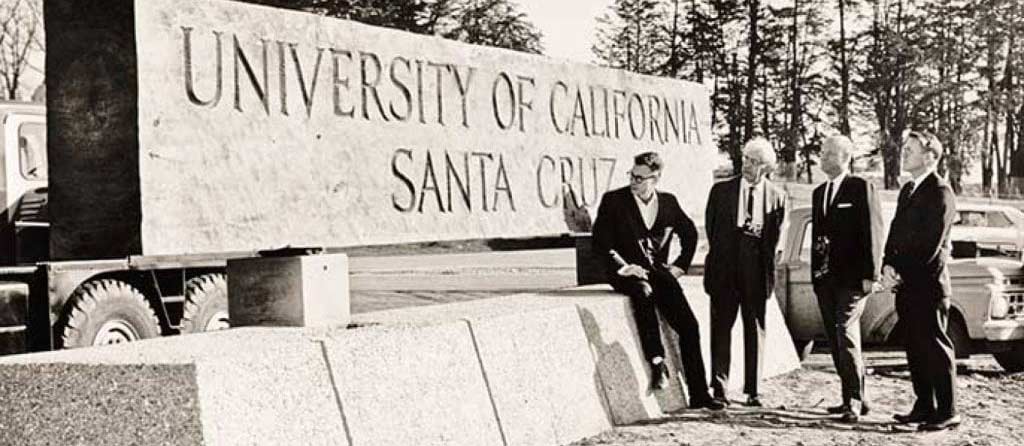
It’s been a milestone-filled year at UC Santa Cruz, with eight major anniversaries across campus. The university marked its 60th anniversary by reflecting on its visionary founding and spotlighting the groundbreaking research and bold initiatives shaping its future. Lick Observatory honored 150 years of astronomical discovery and education, continuing to train the next generation of scientists. The beloved Porter Squiggle sculpture turned 50, recognizing its place in campus and Santa Cruz culture. Several cultural and academic centers reached meaningful milestones: Black Graduation marked 50 years of honoring Black student achievement; the Women’s Center commemorated 40 years of advocacy and support; and El Centro observed 30 years of empowering Chicanx/Latinx students. The Humanities Institute (THI) reached 25 years of public scholarship and innovative research. And the UC Santa Cruz Genome Browser, one of the world’s most widely used genomics tools, marked 25 years of advancing global biomedical research.
Redefining the undeclared student journey
At UC Santa Cruz, having an “undeclared” major is an invitation to explore. The new Undeclared Scholars program, launched in partnership with College Nine and John R. Lewis College, the Institute for Social Transformation, and the Division of Undergraduate Education, is helping students shift the question from “What do you want to do when you grow up?” to “What makes for a meaningful life?”
Through a two-course series, students engage in reflection and discovery, connect with research and internship opportunities, and hear from alumni whose careers grew from curiosity, not certainty. Advisers have embraced this approach, which reframes college as a time to discover what excites and motivates each student rather than rush into a predefined path.
Early feedback has been especially strong among first-generation and underrepresented students. With enthusiastic faculty leadership and strong support from undergraduate advising, this pilot is helping students navigate college with purpose, confidence, and a broader view of success.
New grant strengthens transfer pathway for Central Coast students

UC Santa Cruz and Hartnell College were awarded a competitive $250,000 American Talent Initiative IDEAS Grant to expand Pathways to Success, a program designed to support low-income and first-generation students from the Central Coast. The two-year initiative will streamline the transfer process, provide personalized advising and mentorship, and strengthen academic and career pathways in high-demand fields.
Grounded in a K-16 approach, Pathways to Success builds on the programs and partnerships of UC Santa Cruz’s Educational Partnership Center, which works to expand access to higher education for students across the Central Coast. The program brings together schools, community colleges, and the university to promote student success through a coordinated, regional strategy.
As the only California proposal selected for funding, Pathways to Success is poised to become a model for improving transfer outcomes statewide.
Undergraduate research programs shape academic and career success
At UC Santa Cruz, hands-on learning is a cornerstone of the undergraduate experience. Nearly three-quarters of seniors engage in research or creative projects, a rate nearly three times the national average. Students work closely with faculty across disciplines, from ecology and astrophysics to linguistics and the arts, contributing to meaningful discoveries and creative achievements.
Support comes from a range of programs across campus. Building Belonging connects underrepresented students with faculty-mentored research in the social sciences. Humanities EXPLORE and EXCEL programs provide paid research opportunities for students in the humanities. In the sciences and engineering, students gain real-world experience through faculty labs, fieldwork, and innovative programs like Tech4Good. Several colleges also offer their own research funding, mentorship, and apprenticeship programs that help students build early academic connections.
These opportunities help students apply what they learn in the classroom, gain confidence in their academic and career goals, and prepare for graduate study or jobs after graduation.
Setting the stage: Biggest welcomes yet
The foundation for student success at UC Santa Cruz begins long before fall quarter. Events like Banana Slug Day and Transfer Day give admitted students a chance to explore campus, connect with the community, and learn about the resources and support systems that will guide them throughout their college journey.
In spring 2024, UC Santa Cruz hosted its largest Banana Slug Day yet, with more than 6,500 guests. Transfer Day welcomed over 2,000 students and families and featured a keynote from author and alumna Reyna Grande, who shared her journey as a first-generation transfer student. These events played a key role in many students’ decisions to enroll.
This fall, students who choose UC Santa Cruz will kick off their journey during Welcome Week 2025. Signature events like the Boardwalk Frolic, Downtown Day, and Cornucopia will help new Slugs build connections, feel at home, and start the year ready to navigate college life.
Engaging alumni from the start
At UC Santa Cruz, the Alumni Association begins building connections with students even before graduation. The Almost Alumni Celebration, held the week before commencement and featuring a toast from the Alumni Council, welcomes the graduating class into a growing network of Banana Slug alumni and introduces the many ways to stay connected after college.
From that early introduction, new graduates are invited to participate in a range of innovative programs designed to foster lifelong connections. These include Return to the Redwoods, a signature event that invites alumni back to the beloved campus for a weekend of immersive experiences; a reimagined Alumni Reunion Weekend celebrating class milestones; and the Inspire Series, which highlights groundbreaking research and achievements across the UCSC community. Throughout the year, regional events also bring alumni together across the country, offering opportunities to reconnect with fellow Slugs and engage with the university, wherever their paths may lead.
Powwow returns to Santa Cruz: A powerful celebration of Indigenous culture and community

On May 18, UC Santa Cruz hosted its first off-campus Powwow in over 30 years, drawing hundreds to the Kaiser Permanente Arena in downtown Santa Cruz for a vibrant day of song, dance, and cultural connection. Held on the unceded homelands of the Awaswas-speaking Uypi people, the event honored Indigenous traditions while building stronger ties between campus and local Native communities.
Organized by the American Indian Resource Center (AIRC), the Student Alliance of Native American and Indigenous Peoples (SANAI), and Cabrillo College, the powwow featured 22 Native vendors, food booths, informational tables, and powerful intertribal performances. The event also celebrated recipients of the E.A. Forssgren Scholarship for Native students, highlighting UCSC’s commitment to Native student success. More than a cultural gathering, the powwow affirmed that Indigenous presence and traditions are alive and thriving.
$3 million federal grant fuels CULTURA project to advance Latiné student success
UC Santa Cruz received a $3 million federal HSI (Hispanic-Serving Institution) grant to launch the CULTURA Project—a five-year initiative focused on improving Latiné student success. The grant supports efforts to increase retention, graduation, and transfer student enrollment, while strengthening campus climate and sense of belonging. CULTURA includes expanding services at El Centro, building healthcare pathways for transfer students, offering undergraduate research opportunities, and coordinating holistic support systems. Students are at the heart of the project, shaping programming and participating as researchers and advisors. The project also emphasizes partnerships with community colleges and other campus programs. As one of just 22 Hispanic-Serving Research Institutions in the nation, UCSC continues to lead with a commitment to educational equity and institutional transformation. CULTURA is a vital step in making structural changes that ensure Latiné students are not only supported, but centered, in UCSC’s vision of student success.
Building belonging through family engagement
In a collaborative effort between Student Affairs and Success (DSAS) and University Advancement, UC Santa Cruz launched its inaugural campus-wide Family Weekend in fall 2024, welcoming more than 3,000 parents, siblings, and loved ones to experience the heart of campus life. The weekend marked the beginning of a new tradition rooted in connection, belonging, and student success.
Families participated in a rich array of programs, from Día de los Muertos celebrations and art workshops to faculty meet-and-greets and career readiness panels. The event offered families a first-hand look at the academic and co-curricular journey of their students while strengthening relationships across the university.
To extend engagement year-round, UC Santa Cruz launched the Slug Family Hub in spring 2025. This centralized platform provides families with timely updates, resources, and curated insights to help them stay connected and informed throughout their student’s time at UCSC.
Together, these efforts reflect the university’s deepening commitment to family partnership as a cornerstone of student success. With planning already underway for Family Weekend 2025, UCSC continues to expand opportunities for meaningful connection between students, their families, and the broader campus community.
RISE Clinic expands access to long-term mental health care
As student mental health needs continue to evolve, UC Santa Cruz responded by launching the RISE Clinic—an innovative expansion of Counseling and Psychological Services (CAPS) that provides long-term, culturally responsive care for students with more complex concerns. Unlike traditional short-term counseling models, RISE offers consistent therapeutic relationships and continuity of care, helping students navigate challenges that require sustained support.
The clinic reflects a broader institutional commitment to meeting students where they are, reducing barriers to care, and ensuring mental wellness is woven into the fabric of student success. In its first year, the clinic supported 140 students through more than 700 individual visits—each one a step toward stability, healing, and personal growth.
RISE is one of several recent efforts to strengthen campus mental health infrastructure and represents the kind of adaptive, student-centered solutions UC Santa Cruz is embracing to help students thrive both in and beyond the classroom.